The Netherlands
Extreme precipitation forecasts & flood warnings
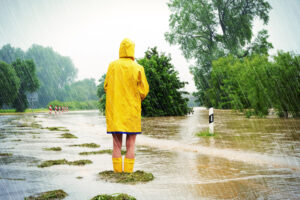
Weather Impact partnered with the Dutch Royal Meteorological Institute (KNMI) to develop an operational warning system for extreme precipitation. The warning system uses innovative statistical techniques on ensemble forecasts and radar nowcasts to generate a combined precipitation forecast at high resolution in place and time. According to the requirements of the specific user, a warning is generated if the forecasted precipitation exceeds the user–specific thresholds. The KNMI focusses in their part on improving the stochastic forecasts of their radar nowcasting product (0 till +2 hours) and HARMONIE short term weather forecasts (0 till +48 hours). Next to an improved forecast of extreme precipitation, a warning system should also be user-friendly and flexible for various end-user groups. Weather Impact investigated the user needs and performed a cost-loss analysis to optimize the warning system. During a one-year trial period in 2021, different extreme precipitation events occur in the Netherlands. These cases have been analyzed and published.
Together with a dozen waterboards, municipalities and Hydrologic, we started a public-private partnership; W2O innovation project. W2O stands for Waarschuwing voor WaterOverlast and is a flooding alert service for government organizations in the Netherlands. Within this project we aim to further develop and improve the service, by offering a localized and more accurate forecast. This way we help the users in their decision making to prevent damages and losses.
More information about the extreme precipitation project and the W2O innovation project can be found on our Dutch website.
Design of an hail-alert system for insurance
In the Netherlands, summer hail with a diameter of two centimetres or more occurs a few times a year somewhere in the country. Larger hailstones, varying from 6 cm to more than 10 cm, come down almost every summer. The hailstorm of June 23, 2016 that passed over the South-eastern part of the Netherlands caused an estimated damage of about 500 million euros. The Dutch Association of Insurers, in collaboration with the KNMI, demonstrated that intense rain and hail showers will cause much more damage in the future climate. Further adaptation to future climatic patterns is needed. To become more climate resilient in the long term, the best way is to keep premiums affordable and insurable is to take preventive measures. A short-term hail notification could support for example car-owners to protect their assets from hail.
In this feasibility study, commissioned by the Dutch insurance company InShared, Weather Impact and Disdrometrics explored the possibility of developing an operational hail-alert system. An operational, full automatic system was designed that warns clients of InShared when they are present in a high risk area.
Workshops
Climate scenario’s; Do we think climate proof?
In this course you will learn about the principles of climate and how climate scenarios can help you in finding solutions for drought, heat and flooding. You will analyse how climate-proof proposed measures are under a certain climate scenario. After the course you can properly substantiate solutions and oversee the consequences of those solutions. Additionally you will have sufficient input for policy making and are you well prepared for future climate.
Weather and water management
This course offers practical knowledge about the weather and weather forecasts, which is for example of great importance when calculating the water level to take preventative measures. The course focuses on practical cases with weather data and water level management. After this course you are better prepared for future climate and do you know how to take the weather aspects into account in your advice and measures in daily water management.

Customized training
We also offer customized and virtual training, right what is required for your organization.
For more information about our work in the Netherlands, see our Dutch website www.weatherimpact.nl